Beginner's Guide to Mixing Throw Pillow Patterns and Colors
A sofa with no pillows looks like a showroom piece waiting for someone to move in. Add three or four and it becomes a room. That is the quiet power of throw pillows: they are small enough to rearrange in five minutes, forgiving enough to cover a mistake, and inexpensive enough that you can try something slightly odd without regretting it. The hesitation usually arrives in the store, when you are holding a striped pillow in one hand and a floral in the other, wondering whether they belong together. Most of the time, they do. Here is how to tell.
Start With the Room, Not the Pillow Aisle
Before you buy anything, walk into the room and note three colors that are already there. The rug, a piece of art, the curtains, the upholstery, even a lamp base or a stack of books. Write them down. Those existing colors are the ones your pillows should answer to, which is why a pillow that looks perfect in a shop can fall flat at home.
A neutral sofa — cream, oatmeal, gray, camel, or charcoal — gives you the most freedom, because almost any two colors will sit comfortably on it. A green velvet sectional or a checked armchair is a different story: the palette is largely decided for you, and your job becomes echoing what is already there rather than introducing a new direction.
One more check before you shop: how busy is the room already? If your rug has a bold medallion print and your curtains are patterned, your pillows should be quieter. Pattern needs somewhere to rest.
Build a Three-Color Palette, Then Stop
Three colors is enough for a sofa or a bed: a dominant color, a secondary color, and an accent. The neutral base does not count. For example, on a cream sofa, navy could be dominant, rust secondary, and blush or olive the accent. Two of your pillows carry the dominant color, one carries the secondary, and one small pillow carries the accent. That distribution is why some pillow groupings look intentional and others look like a collection.
Resist the urge to add a fourth color. The eye counts, even when you are not consciously counting, and four competing colors in a two-foot space reads as clutter rather than variety.
Know What Each Pattern Does
Patterns are not interchangeable. Each type behaves differently in a grouping, and knowing the job each one does makes mixing far easier.
- Solids: the rest stop. A solid pillow gives the eye somewhere to pause, so it is the piece that makes bolder patterns look deliberate.
- Stripes: structure and rhythm. Vertical or horizontal, they add movement without adding a new color story.
- Florals: softness and a little romance. Large blooms feel dramatic; small sprigs feel traditional and calm.
- Geometrics: energy. Diamonds, chevrons, and grids feel modern and pair naturally with a floral because the shapes are so different.
- Small-scale dots, checks, and ikats: texture from a distance. They read almost as solids across the room, which makes them useful fillers.
Vary the Scale, Not Just the Motif
This is the rule most beginners miss. Two patterns of the same scale fight each other, even when the colors match. A large cabbage rose next to a large paisley reads as noise. The same rose next to a fine pinstripe reads as design.
A dependable formula: one large-scale print, one medium-scale print, one small-scale print, and one solid or heavily textured pillow. Then repeat that thinking every time you add a piece.
If your eye does not know where to land, you have too much of the same thing. Take one pillow away before you add another.
Sofas and Beds Ask for Different Things
On a sofa
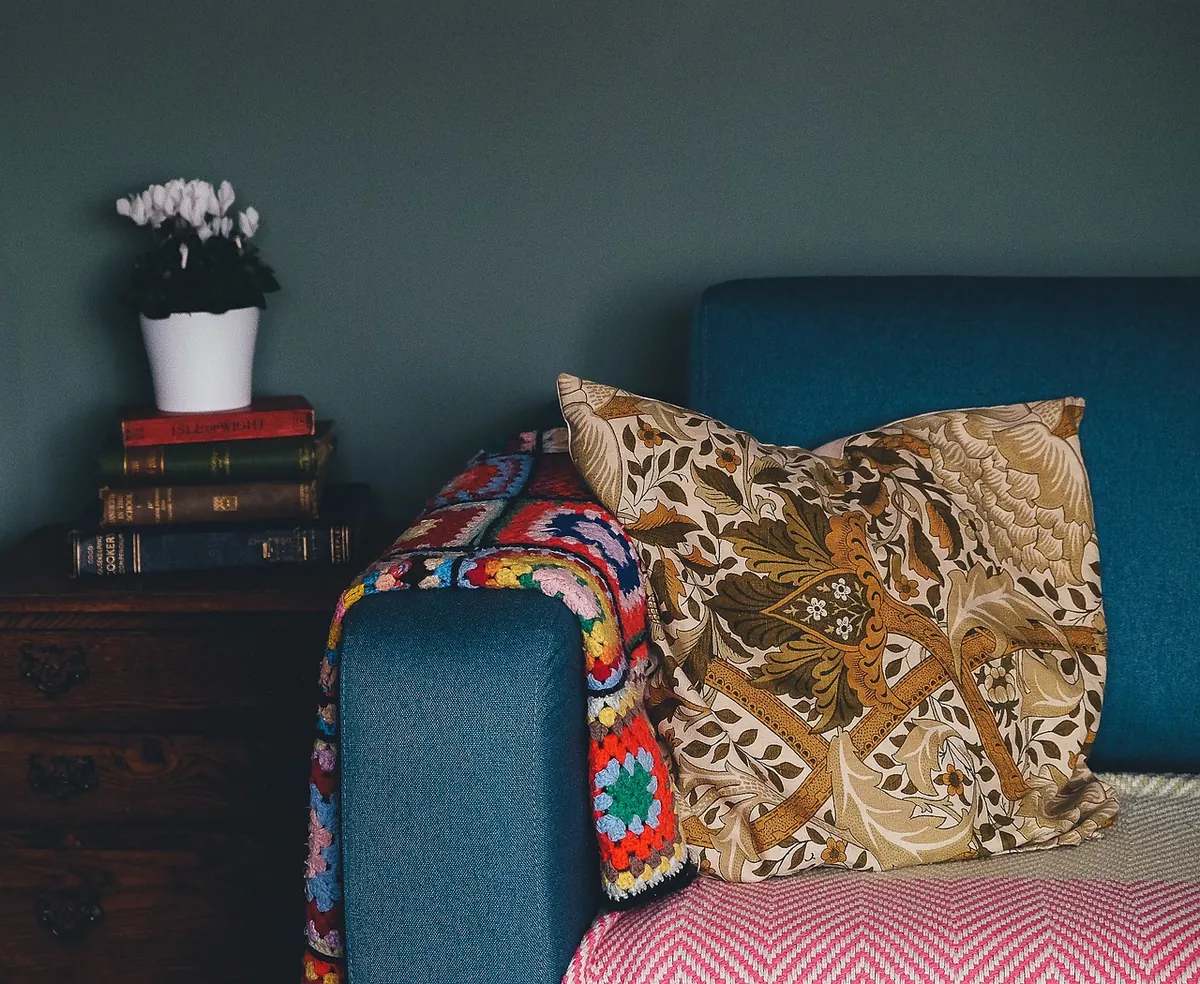
Work in odd numbers — three for a loveseat, five for a full-size sofa — and place them in the corners rather than spread evenly like fence posts. Put the largest pillow at the back of each corner, a medium one in front of it, and the small accent pillow in the middle or on one end. Repeating a color once on the left side and once on the right gives the eye a path to follow. Mix at least two fabrics, such as velvet with linen or cotton with wool, because texture separates pillows that share a similar color.
On a bed
Beds can take more symmetry. Start with two large square pillows at the back, add two standard pillows in front, then finish with one lumbar or a single accent pillow in the center. If you want a softer look, pair a floral with a stripe in the same two colors and let the solids do the calming. On a bed, matching the pillow palette to the wall color or the bedding keeps the whole thing from feeling busy.
The Five-Minute Edit
When you think you are finished, lay everything out, step back six feet, and look. Better still, take a photo on your phone. Photos make imbalance obvious in a way your eye forgives in person. Then squint, or switch the photo to black and white: if the arrangement turns into a gray blur, you need more contrast; if it looks like a checkerboard, you need a solid in the mix.
Make one change at a time and re-check. Remove a pillow, swap two positions, or replace the loudest one with a plain textured cover from another room. Pillows are the cheapest thing in the room to change, so treat the arrangement as something to adjust rather than something to get right the first time. Buy covers instead of whole pillows where you can, store the spares in a basket, and rotate them with the seasons. The room will feel new for the effort of walking to the closet.
Photo: StockSnap / Pixabay